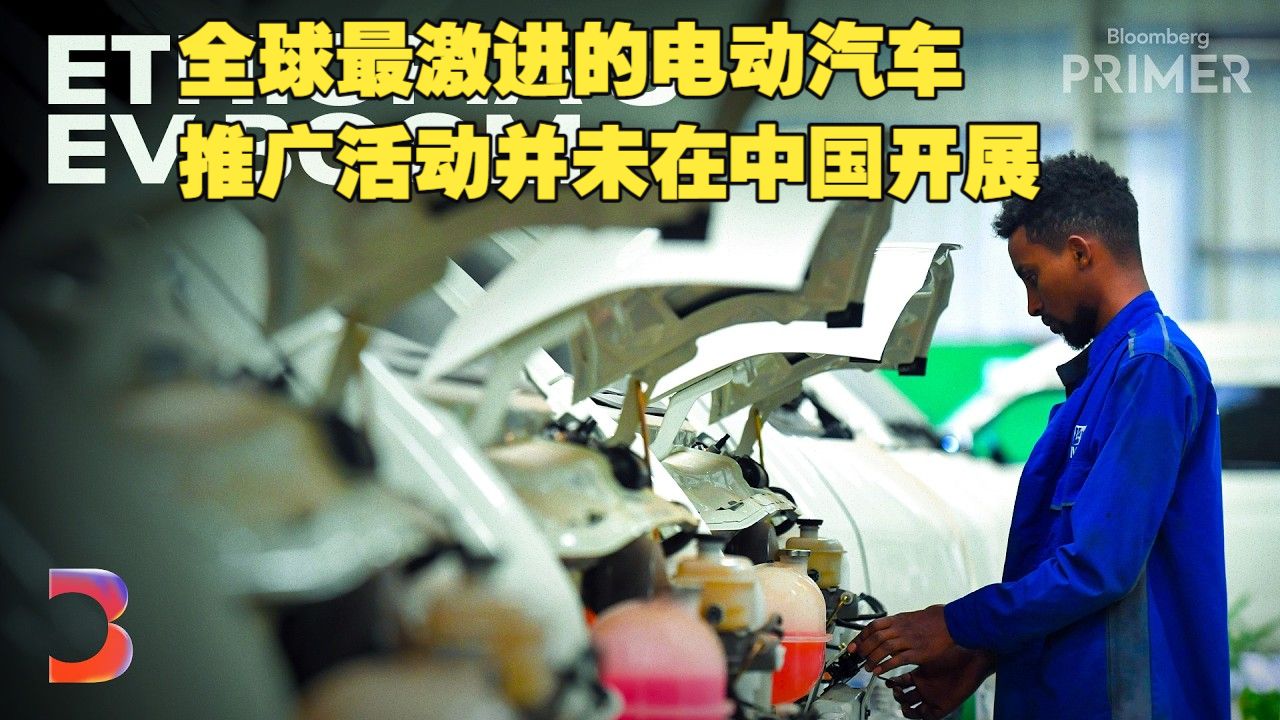
全球最激进的电动汽车推广活动并未在中国开展 | 彭博社 2026/11/3
埃塞俄比亚为缓解燃油进口和外汇压力,自2024年起全面禁止燃油车进口,依靠廉价水电、中国电动车供应与本地组装政策快速推进汽车电动化,但仍面临电网薄弱、购车成本高和地区动荡等挑战。
-
政策核心是禁止进口燃油车,已有车辆仍可使用。 据视频介绍,埃塞俄比亚自2024年起禁止汽油和柴油车辆进口,成为首个全面实施这一政策的国家。境内原有燃油车并未被没收,仍可继续上路;与其他国家长期分阶段退出的计划相比,其政策落地非常迅速。
-
转型首先是经济与能源安全选择。 埃塞俄比亚每年燃油进口支出最高约 50亿美元,长期补贴燃油进一步加重财政负担。该国2023年发生债务违约,随后获得国际货币基金组织 34亿美元救助;燃油短缺也让加油排队动辄持续数小时甚至数天。
-
电动车数量迅速增长,但统计存在口径与核验限制。 政府数据显示,电动车保有量从2022年的约 7,000辆增至2025年的 10万辆以上,视频明确指出这些数字尚无独立评估支持。另一项美国贸易机构估计称,禁令实施前已有约 3万辆电动车。2024年,首都亚的斯亚贝巴新登记汽车中超过 60%为电动车;全国道路车辆中的电动车占比据称由禁令前约 1%或以下升至 6%,高于视频引用的全球平均 4%。
-
低用车成本形成直接吸引力。 视频中的出租车司机每月总收入约 480美元,使用电动车可节省约 150美元/月,相当于月收入的约三成。视频引用的平均电价为:埃塞俄比亚约 0.10美元/千瓦时,美国约 0.18美元/千瓦时,英国约 0.40美元/千瓦时。
-
大型水电工程提供能源基础。 埃塞俄比亚复兴大坝位于青尼罗河,建设历时约 14年、耗资约 50亿美元,发电装机容量约 5,000兆瓦,是非洲最大的水电站。全国约 99%的电力来自清洁能源,其中约 96%来自水电,并向周边国家出口电力。
-
发电能力充足并不代表供电普及。 全国约 1.3亿人口中,仅约 55%能够用电,停电也较常见。燃油车进口禁令生效时,公共充电设施几乎空白,早期车主主要依靠家庭充电;此后公共充电站增至约 200座,并向 Adama、Hawassa 等城市扩展,形成“车辆先普及、设施后跟进”的路径。
-
中国供应链支撑车辆供给,关税鼓励本地组装。 当地经销商销售的电动车几乎都从中国进口,主要为中国品牌。视频列出的进口关税分别为:整车约 15%、半散装套件(SKD)约 5%、全散装套件(CKD)为 0%,以此推动进口商在当地组装并创造就业。
-
本地制造仍处于起步阶段,公共交通是重要应用场景。 政府已向约 17家电动车组装企业发放许可,但据视频介绍,仅 BKG Manufacturing 已投产。其使用中国南京金龙提供的零部件组装电动小巴,中方工程师培训后,由埃塞俄比亚员工接手生产流程;产品售予私人运营者、企业和市政府,市政府是最大单一买家。目前工厂约每天生产 1辆车,另计划于 2027年启动乘用车组装。
-
高购买价格限制普及,电动车占比高不等于汽车普及率高。 一辆 BYD Seagull 在当地售价约 2.3万美元,而人均年收入不足 1,000美元。当地每千人仅约 13人拥有汽车,远低于视频引用的非洲平均 73人/千人;因此,小规模汽车市场既便于快速转型,也意味着多数居民仍依赖公共交通。
-
扩张目标明确,实施仍有多重约束。 埃塞俄比亚在2025年气候计划中提出,到 2033年实现 50万辆电动车、超过2,000座充电站。能否达标取决于车辆可负担性、组装产能、电网与充电设施建设,也受到国内冲突、围绕大坝的地区争端及国际能源价格波动影响。
-
这场实验表明,发展中国家也可能快速推进电动化,但条件难以直接复制。 廉价水电、规模较小的汽车市场、紧迫的燃油进口压力,以及中国电动车供应,共同促成了这次转型。视频的核心判断是:快速转型的动力可以来自财政和能源约束,而不只来自气候承诺。
注:以上数据与事件按文字稿整理;其中2026年冲突、2027年会议安排等表述,以及部分统计口径,未作独立核实。
▸ 原始转写文字稿(11135 字符)
You might think the future of electric vehicles belongs to Norway, China, maybe California, but the place moving faster than almost anywhere else isn't rich. It isn't famous for making cars, and roughly half the population still doesn't have reliable electricity. EVs have quietly arrived in Ethiopia. Suddenly, Ethiopia, one of the poorest countries in the world, decided it's just going to go ahead and do what none of the richest countries have done. In 2024, this country banned new gas cars, completely. The government banned the import of petrol and diesel vehicles, a very radical move. Ethiopia's vehicle fleet is going electric faster than most of the world. It's working, mostly. Automobile dealerships, you'll see only EVs. You don't see fuel cars because of the ban. One country, one enormous experiment. And a question, what happens when a country decides it can't afford gasoline anymore? Ethiopia is the first country to fully ban the import of fuel cars. To be clear, nobody's car was confiscated. Every gas-powered vehicle already in Ethiopia could stay on the road. But beginning in 2024, no new ones could enter the country. Plenty of countries have pledged to do something like this. The UK, Canada, members of the EU. But these pledges would phase out gas cars over the course of a decade. And many have been quietly walked back. Ethiopia did it almost overnight. Forget climate for a minute. Follow the money. Ethiopia imports more than it exports. One of the major things that import is fuel, up to $5 billion a year. $5 billion. For years, Ethiopia subsidized fuel with money it didn't really have. In 2023, it defaulted on its debt. Ethiopia failed to make an interest payment on its bond, making it the latest default in Africa. Officials are scrambling to avert a financial meltdown. Then the International Monetary Fund stepped in with a $3.4 billion bailout. Gasoline in Addis has been tough. We observe long queues at gas stations that take hours and sometimes days. Natanael Tedese, no relation to Farsaka Tedese, is a taxi driver in Addis, Ababa. That's the equivalent of saving around $150 a month out of his total income of around $480 a month. Natanael isn't alone. In 2024, more than 60% of newly registered cars in Addis Ababa were electric. And the number of EVs on Ethiopia's roads has exploded from 7,000 in 2022 to more than 100,000 in 2025. Just to note, these are government figures. We do not have independent assessments of those figures. The U.S. International Trade Organization puts the figure at around 30,000 before the gas car ban was in place. But talk to anybody on Addis Ababa streets and they'll tell you they're just seeing a lot more electric vehicles on the road. Before the full ban in 2024, the EV penetration was about 1% or below that. Today, EVs make up 6% of all vehicles on the roads. And the global average is 4%. So in a mere two years, Ethiopia has essentially leapfrogged the rest of the world in adopting electric vehicles. So how'd they do it? Step one, cheap electricity. Ethiopia can't afford oil. But electricity, it now has some of the cheapest in the world. In Ethiopia, the average price of electricity is about 10 cents per kilowatt hour. And just to put that in context, the average price of electricity in the U.S. last year was about 18 cents per kilowatt hour. In the U.K., it was about 40 cents per kilowatt hour. Which probably raises a question. How is Ethiopia making electricity this cheap? All of it traces back to one giant piece of concrete on the Blue Nile. Last year, Ethiopia inaugurated the Grand Ethiopian Renaissance Dam that produces about 5,000 megawatt energy, which significantly increased the country's power generating capacity. It's the largest hydroelectric power plant in Africa. It took 14 years, about $5 billion, and a long fight with Egypt over water rights. It is indeed a historic day for Ethiopia. A marvel of engineering, and a boon for the prosperity of the people of this region. 99% of Ethiopia's electricity comes from clean sources. 96% from hydropower. And it produces more than enough for Ethiopia, enough to be able to export to neighboring countries like Tanzania, Kenya, and Djibouti. But generating electricity isn't the same as moving it. And Ethiopia's grid is a challenge. Ethiopia has about 130 million people. According to a recent estimate, only about 55% of the people have access to electricity. Blackouts are common, too. This all makes charging EVs difficult. And when the ban took effect, Ethiopia had almost no public charging stations. In the West, it would be a shock and horror if you brought in a ban on fossil fuel cars, and you did not have a fast charger. It's a classic chicken and egg problem. Nobody buys EVs because there aren't enough chargers. And nobody builds chargers because there aren't enough EVs. But in Ethiopia, most people are charging at home. And the charging infrastructure came after car sales started to begin. So the chicken and an egg situation had the chicken first and the egg came later. Today, the country has around 200 public charging stations. And the network is pushing into more cities like Adama and Hawassa. Cheap electricity gets you halfway. You still need something to plug in. And Ethiopia doesn't really make cars. Walk into a car dealership in Addis Ababa, and nearly everything on the lot comes from one place. Almost all of the car dealerships are selling EVs that are imported from China, mainly Chinese brands. About five years ago, China wasn't exporting very many vehicles at all, whether they were electric or not. And today, China is one of the world's largest exporters of all vehicles. It is exporting more vehicles than Germany and Japan. So if the Ethiopian story feels like a sideshow to Western automakers, the global figures should worry them. But Ethiopia didn't just want to buy Chinese cars. It wanted to build them with Ethiopian workers. So it made importers an offer. If you import a fully assembled EV, you pay about 15% in tariff. But if you import a semi-assembled car in a kit of parts, known as semi-knockdown or SKD, you pay just a 5% tariff. And if you get the car fully in parts, like a full Ikea flat pack situation, known as completely knocked down or CKD, then you pay no tariff at all. Somebody in the country will assemble it for you and then you can sell it at 0% tariff. Ship a finished car, pay the tax. Ship a box of parts, pay nothing. So the boxes started arriving. 30 kilometers outside the capital, this is what that policy looks like in action. The government has licensed about 17 EV assembly companies. But so far, only one of them, BKG Manufacturing, started operation. Bulayne Kinde Group started in 1991 as an import-export business. Today, it's one of Ethiopia's largest private conglomerates. Everything from hotels to farms to construction, and since 2018, vehicles. And it's not just cars that are going electric. What rolls off the line here are minibuses, the shared taxis commonly used across Addis. Since most people do not have their own cars, people are dependent on public transports. The big buses are owned by the city administration, and the minibuses are run by individuals who provide transportation service. The Chinese automaker Nanjing Golden Dragon Bus Company supplies the parts to BKG that it assembles together. At first, Chinese engineers ran the floor alongside Ethiopian workers. That changed fast. When I went for the second time, Ethiopian employees were fully trained by the Chinese. And now they took over every process by themselves. The market is the market. The market is the market. The market is the market. The market is the market. The market is the market. The market is the market. The market is the market. The market is the market. The market is the market. The market is the market. Many BKG minibuses go to private drivers and companies. But its biggest single buyer? The city itself. The market is the market. The market is the market. The market is the market. The market is the market. The market is the market. The market is the market. The market is the market. The market is the market. Ethiopia's ambitions have grown fast. In its 2025 climate plan, it set a goal of reaching 500,000 electric vehicles and over 2,000 charging stations by 2033. The question now is whether it can make EVs affordable to new waves of buyers. The real sticking point for most Ethiopians to still buy electric vehicles is the sticker price. Electric vehicles are still many, many times more than the average salary of an Ethiopian. A small EV here, like the BYD Seagull, runs about 23,000 US dollars. Average yearly income per person is less than 1,000 US dollars. Which is why Ethiopia has one of the world's highest EV shares and one of its lowest rates of car ownership. 13 people out of 1,000 own cars. So this is way below the African average, which is 73 of the 1,000 people. There's also a supply problem. Ethiopia wants to kickstart a car industry, a tall order. This BKG plant builds about one vehicle a day. BKG is already working on another plant. This one for passenger cars to begin assembly in 2027. It's still a long way from Ethiopia's target. But the biggest obstacle may have nothing to do with factories. In September 2026, fighting broke out in Ethiopia's northern Tigray region. Almost four years after a peace deal was signed to end a deadly civil war between the government and the Tigray people's liberation front. Ethiopia accused Eritrea, Egypt and Sudan of supporting the rebels. All three deny it. Ethiopia has grown increasingly isolated in the region. Partly because of the Grand Ethiopian Renaissance Dam, which Egypt and Sudan opposed. Ethiopia's prime minister has also made access to the Red Sea a national priority, fueling speculation about the future of Eritrea's port of Assab. Instability at home and in the Middle East makes the move away from oil even more urgent. The battle for Hormuz intensifies, sending energy prices higher across the board. The price of crude oil shot to its highest level since 2023. This is a volatile market. The prices of oil have shot up 40 and 50 percent. What we can see is that the number of electric vehicles sold in developing countries in general has been rising much more quickly than before the Iran war started. Ethiopia isn't slowing down. Another hydropower plant is already under construction due by the end of the decade. And in 2027, Ethiopia will host the UN Climate Summit in Addis Ababa. The government is excited to show to the world what an electric vehicle transition can look like from the perspective of a developing country. This national experiment doesn't exactly copy paste. Most countries don't have a river like the Nile or a car market small enough to turn this quickly or a fuel crisis big enough to force the question. But it does settle one argument. The question was never really whether a country could do this fast. It was whether one would. Rich countries have spent two decades planning for a future they keep postponing. Ethiopia couldn't afford to wait. So it didn't.